
Search myodfw.com
Showing 621 - 640 of 1410 results
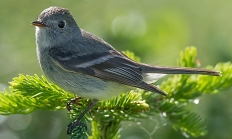
The Hammond's flycatcher spends much of its time in tall conifer canopies, where its subdued plumage and quiet, monotonous chant let it be easily overlooked. A diligent observer may be able to locate this aerial insectivore on a dead limb just beneath the live crowns of mature conifers from which it sallies into a canopy gap to capture insect prey on the wing. It is a common summer resident of montane coniferous forests through the state, on both sides of the Cascades. Hear the song of the Hammond's flycatcher Photo by Keith Williams, Flickr
Noted for its familiar call, chick-a-dee-dee-dee, the Black-capped chickadee is widely heralded as one of Oregon's friendliest and cheeriest residents. Even in the midst of winter, this bird "fairly overflows with good spirits." The Black-capped chickadee is resident at low to moderate elevations in western Oregon from the Willamette Valley and coastal counties to Douglas County and in most of eastern Oregon with the exception of the southeastern corner of the state. Hear the song of the Black-capped chickadee Photo by Dave Budeau, ODFW

This large sparrow is white below and in most plumages has at least some black around the face or throat, more in adults than younger birds. Cheeks are golden-tan in fall and winter and grayish in spring. It is streaked above. It is a winter visitor usually found with other sparrows. A very rare migrant and rare but regular visitor, you can find the Harris's sparrow statewide. Numbers vary considerably from year to year, but a few birds are typically found in the state every year. They are most regular in the Columbia Basin and in valleys within the Blue…

The sagebrush vole is among the smaller voles in the state. The tail does not exceed the length of the hind feet. The long, soft, and dense dorsal pelage is grayish tan; the bases of the hairs are lead colored and the tips are black. The ventral pelage is pale buff, the feet light gray, and the tail slightly bicolored. In Oregon, it occurs mostly east of a line connecting The Dalles, Bend, and Klamath Falls, except it is absent from the Columbia Basin and most of the Blue and Wallowa mountains. Clustering of burrows tends to indicate that the…

Smaller than a robin, this shy skulker is difficult to see, even though it is present during the nesting season in marshes throughout the state. The Sora is mostly brown with a black face and a stout yellow bill. Its chicks are small black balls of fluff with a bit of orange feathering under their chins. In the breeding season, Soras use wet meadows, including sedge, rush, and hair grass types but also wet areas with emergent vegetation, particularly cattails and tulles. They eat invertebrates, seeds, plant leaves, and stems. Hear the call of the Sora Photo by Kathy Munsel…

The only sapsucker regularly found in western Oregon, the Red-breasted sapsucker, with its raspberry-red head and breast, is unmistakable. It is found in moist coniferous coastal forest and mixed deciduous-coniferous coastal forest west of the Cascade crest, and in aspen-ponderosa pine forests east of the Cascades. Nest cavities are typically in large snags or live trees with decayed interiors. It is a fairly common breeder in the northern part of the state from the coast to the Cascades and south to the southern Cascades. Hear the call of the Red-breasted sapsucker Photo by Darla Marie Prater

The more distinctive features on this gray and greenish vireo are the bright eye rings and lores, together called "spectacles." This bird is often difficult to see as it forages among the foliage; identification is usually based on hearing its distinctive song. Widespread in migration, when its habitat includes city parks and heavily wooded neighborhoods. The Cassin's vireo is an uncommon to rarely common summer resident in forests and woodlands, except along the immediate coast. it is an uncommon transient throughout the state. Hear the song of the Cassin's vireo Photo by Trish Gussler, Flickr

Gray jays are common visitors at mountainous campsites and parks and are commonly known as "camp robbers" for their habit of taking food from humans. Gray jays in the Blue Mountains have the top of their heads white, while birds in the Cascades and Coast ranges have white restricted to the forehead. Coast Range birds are decidedly browner vs grayish overall. In Oregon, the Gray jay resides in conifer forests of the Coast and Cascade ranges, the eastern slope of the Cascades at Ft. Klamath and in the southwestern part of the state. Hear the call of the Gray jay…

This is a sparrow of the dry brushlands. The Clay-colored sparrow breeds chiefly across the northern prairies from northeast British Columbia east to Michigan and south into Colorado. It winters in the southern United States and Mexico. It has expanded its range westward and northward in recent years and is now nesting in small numbers in eastern Washington. It was seldom reported west of the Rocky Mountains prior to 1960. Since that time, it has become a regular migrant and wintering bird along the west coast. Hear the song of the Clay-colored sparrow Clay-colored sparrow. Photo by "Always a birder"…

One of the most nondescript birds found in Oregon, this sparrow makes up for its drab appearance by its extraordinary song. It is by far the most abundant bird breeding in the vast sagebrush expanses of the Intermountain West. The Brewer's sparrow is an abundant migrant and summer resident east of the Cascades summit, particularly in the southeast quarter of the state among the vast sagebrush communities of the Great Basin Shrub-steppe. In the Columbia Plateau ecoregion, it is an Oregon Conservation Strategy Species. Hear the song of the Brewer's sparrow Photo by Dave Menke, USFWS

The Snow bunting is a large finch that breeds throughout the high arctic tundra. In winter, many move south, sometimes forming large flocks in open grasslands, steppes, and dunes. When feeding in agricultural fields, these flocks may be hidden among the stubble, but when alarmed they often arise as a group and whirl about in a white cloud before returning to their spot or a nearby one. Oregon is at the southern edge of their winter range, and their wanderings about the state are erratic. In basic plumage, they are buffy and cream-colored with black and white wings. Hear the…

The vagrant shrew can be distinguished from all other congeners in Oregon by the combination of the upper unicuspids wider than long in ventral view. It is light medium brown on the dorsum, light pinkish-gray on the sides, and white on the venter, bases of hairs on all three areas are neutral very dark-gray. The tail is weakly bicolored (dark brown over white) in juveniles. The vagrant shrew occurs throughout the state except in the Columbia Basin. It tends to be more of a generalist than most Oregon shrews in terms of habitat affinities, nevertheless, it usually is found in…
The Western gray squirrel is the largest tree squirrel in the state. It occurs from central Wasco, Jefferson, Deschutes, and Klamath counties west, except for unforested portions of the Willamette Valley, to central Washington, Benton, Lane, Douglas, Coos, and Curry counties. It is commonly associated with mixed forest communities. These squirrels are wary and secretive, but curious; they examine new objects placed in their environment but, once captured, they often avoid live traps. Western gray squirrels are an Oregon Conservation Strategy Species in the Willamette Valley ecoregion. Photo from ODFW

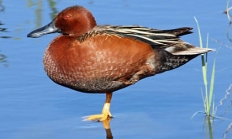
The bright rusty plumage of the male cinnamon teal, a bird of western North America, is a visual delight. In flight, both males and females show powder blue in the wings as they fly fast and low, timed at nearly 60 miles per hour. They weigh only about one pound. They are a common breeder throughout the state except in western Oregon and the high Cascades. They are most common east of the Cascades. Hear the call of the cinnamon teal Photo by Maxine Wyatt
This northern grouse reaches Oregon only in the forests of the Wallowa Mountains in the northeastern part of the state. It is dusky and slightly smaller than the ruffed grouse. Sexes are different in coloration; males have a black breast with white spotting on the sides, white spots at the base of a black tail, and a red comb above the eye. Females are heavily barred with dark brown and white and have a dark tail. Hear the call of the spruce grouse Spruce grouse observation form Photo by Dave Budeau, ODFW

This majestically crested bird is often heard before being seen due to its conspicuous harsh rattling call. Kingfishers are most frequently associated with lake and pond shorelines and islands, as well as coastal dunes with ponds and widely scattered shrubs and trees. They hunt from a vantage point above water such as an overhead branch, telephone wires along shore lines or pilings of piers. This is a common permanent resident throughout most of the state except in the north Lake and east Deschutes counties where open water is generally absent Hear the call of the belted kingfisher Photo from ODFW

Ravens are clever, innovative, and entertaining. They quickly exploit human-created opportunities for food and shelter. Their spectacular aerial acrobatics conducted under windy or thermal conditions appear to be an act of fun. The Common raven's plumage is entirely shiny black like the American crow, but the ravens appear 25 percent larger, have a wedge-shaped tail and have deeper croaks and other calls than the American crow. In Oregon, the Common raven is a fairly common, widespread resident in many habitats throughout the state; population densities are highest east of the Cascades. Hear the call of the Common raven Photo by…

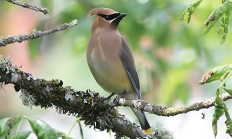
One of Oregon's most efficient fruit-eaters and a perennial irritant to cherry, blueberry, and grape growers, the Cedar waxwing is a sleek, social resident of mixed forests and urban areas throughout the state. Smooth, tan-brown plumage, a black mask with a mall head crest, red waxy wingtips, and a yellow tipped tail give Cedar waxwings a distinctive appearance. The breeding range of the Cedar waxwing covers most of Oregon, except for the extensive conifer forests and expansive treeless areas with greater breeding populations reported in lowlands. Hear the call of the Cedar waxwing Photo by Kathy Munsel, ODFW
Familiar to anyone from the eastern United States and Canada, this sparrow is much less common in Oregon. Adults show both a white-striped and tan-striped morph, while first year birds resemble tan-striped adults but are typically more heavily streaked underneath. Even the dullest first-year birds have a distinct rectangular white throat patch, often set off with a partial black border. The White-throated sparrow is an uncommon migrant and winter visitor, mainly in western Oregon. Hear the call of the White-throated sparrow Photo by ©Keith Kohl, ODFW
