
Search myodfw.com
Showing 721 - 740 of 875 results
This medium-sized flycatcher has expanded its breeding range from northern California to southwestern Oregon and continues to expand its range in Oregon. First experiences with the species may bring to mind a Slate-colored Junco behaving like a flycatcher. The Black phoebe is dull, sooty black overall, somewhat paler on the back, with a white belly contrasting with the black breast and sides. Bill, legs, and feet are black. The phoebe dips its tail repeatedly. Black phoebes are associated with water. Slow-flowing, idle, or slack water of large rivers, streams, and creeks, ephemeral and permanent ponds, lake shorelines, irrigation ditches, and…

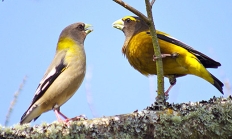
This sturdy-looking bird has a large head, short tail, and massive conical bill adapted for seed eating. The male plumage features bold patches of lemon yellow shading into olive, then brown and black, with white secondaries creating a flashy wing-patch easily seen in flight. The male's bill is chalky white in winter, but changes in early spring to a pale green that matches the new growth at the tips of spruce boughs, where they often nest. Many encounters with this species are of individuals heard flying high overhead, leaving the observer with little else to note. The Evening grosbeak is…
The Steller (or Northern) sea lion is the largest member of the family Otariidae. Among adult females and subadult males, the upper body is slim, whereas in adult males it is heavy and muscular. The head is bearlike with a moderate step between muzzle and forehead. The rear flippers are relatively small and can be turned beneath the body for travel on land. The pelage is light buff to reddish brown, slightly darker in the chest and abdomen. Overall the pelage appears darker when wet. However, beneath the water it appears white, whereas the California sea lion appears black. In…

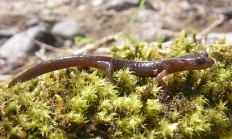
Adult clouded salamanders are generally brown with brassy patches on their backs and gray bellies. As salamanders age, the brassy color fades. The clouded salamander is one of the lungless salamander species; they breathe through their moist skin. Mature adults can grow to just over five inches in total length. Clouded salamanders prefer forest habitats or burned areas that provide large decaying logs or stumps. They are often found in Douglas fir trees where they can find burrows in the wood, or spaces just under the bark to hide. They may also hide deep in rock crevices during dry and…
Adults have smooth, moist skin that is brown or reddish-brown in color with black flecks on their backs, sides and legs. They may also have a dark colored mask. Adults have red underlegs, hence their name. Females, growing to four inches in length, are almost twice the size of males. Adult red-legged frogs like cool damp coniferous or deciduous forests and forested wetlands. During the non-breeding season, adult frogs spend most of their time on land in woodlands along streams, in moist sedge or brush, along shaded pond edges or under logs and other forest debris. Damp weather permits them…

If this is a new activity for you, our friends at the Audubon Society have tips on how to start birding and how to connect with other birders. This is a great resource that also includes tips on choosing binoculars, reviews and recommendations on the best birding apps and field guides, and an easy seven-point guide on how to identify birds. The Cornell Lab of Ornithology has an extensive website that includes the world's largest archive of wildlife sounds and videos, bird cams, eBird citizen science opportunities, scientific publications, bird guides, bird nesting box plans and more. ODFW's Living with…
When mention is made of ducks, many people first think of the mallard. Its ability to tolerate human disturbance and adapt to urban as well as rural habitats make it the Northern Hemisphere's most abundant and widespread waterfowl. Females are mottled-brown, with dark brown stripe through the eye, orange bill with black splotching and have yellowish-orange legs. Immatures resemble adult females until males acquire nuptial plumage usually by mid-November. Males enter the eclipse molt in June and resemble hens until mid-September. Wings of both sexes have a violet-blue speculum bordered in front and behind by a pronounced white stripe. They…

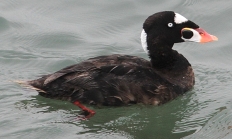
Although the least numerous scoter on the continent, it is the most common scoter along the Pacific coast south of Alaska and winters by the thousands off Oregon. Adult males' plumage, black except for white patches on the forehead and nape, yields attention to the bill, a swollen white, red-orange, yellow, and black wedge feathered squarely along its base. The highly visible standard advertises male's presence for up to a mile. Dark-billed adult females and subadults are dark brown above and paler brown below, with two indistinct light patches on the cheeks and sometimes on the nape. A flattened head…
With four wing-beats each second pushing them to 62 miles per hour, brant are the fastest and strongest geese in flight and among the swiftest of all large birds. Black brant comprise the vast majority of brant occurring in Oregon. These small geese have smoky black backs and bellies, and dissected white collars and white around the tails provide striking contrast. The black brant can live up to 20 years and are resilient enough to ride out storms on the open ocean. In Oregon, wintering numbers along the coast have seen a 50 percent reduction from previous years due to…

This is one of the most widespread and familiar waterbirds in Oregon. It is the largest heron in North America, standing approximately four feet tall. It is slate gray with a white crown, cheeks, and throat, rusty thighs and a uniformly yellow bill. Adults develop long gray-white plumes on chest, neck, and back during breeding. Juveniles have similar plumage but may be distinguished by absence of breeding plumes, a dark crown, and dark upper bill. Great blue herons frequent many habitats from shallow areas of marshes, lakes, streams, and oceans, where they feed on fish, amphibians, and aquatic invertebrates; to…

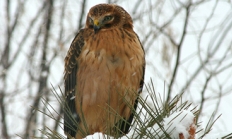
The Northern harrier is a slender, medium-sized hawk characterized by a noticeably long tail, bold white rump patch, and owl-like face. Commonly encountered in large expanses of open country, its main hunting technique is through use of a distinctive buoyant, gliding flight low over the ground that relies heavily on visual as well as auditory cues to detect prey. The larger females have rich brown upperparts while adult males are mostly light to medium gray, sometimes appearing almost ghostly silvery-white. Males are noted for their high-spirited and acrobatic courtship displays, in particular a series of dives and barrel rolls in…
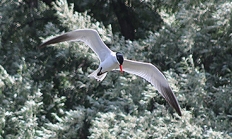
The Caspian tern nests on flat sandy or gravelly areas on islands, or on the margins of lakes, rivers, and marshes. It is always near water, and forages both in nearby water bodies and on prey exposed in nearby open areas. Breeding colonies in recent years have been on islands in the Columbia River east of the Cascades in north central Oregon; Malheur and Harney lakes in southeast Oregon; Summer Lake and lakes in the Warner Valley in south central Oregon. Most colonies have a history of intermittent use. It is a locally common summer resident during breeding season within…
The Tufted Puffin is extremely charismatic and the most recognized seabird in Oregon. It is easily identified in the breeding season by the colorful laterally compressed bill, a distinct white face with long cream-colored facial plumes, black body, and reddish-orange feet. In winter it moves offshore and loses most of its colorful plumage and bill plates. Tufted Puffins are burrow-nesters and feed at sea. Along the Oregon coast, they primarily nest on soil-covered islands free of mammalian predators. They also occasionally nest on headlands such as Cape Mears, Cape Lookout, Cape Foulweather, and Yaquina Head. Tufted Puffin populations have…

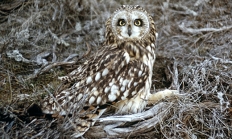
The Short-eared owl is one of our most conspicuous owls owing to its use of open country and crepuscular habits. It is often seen hunting low over the ground across marshes, fields, and other open areas on its buoyant, long wings, flying slowly and irregularly like a giant moth. This owl also differs from most other owls as it seldom vocalizes and is more often seen than heard. It was named for its inconspicuous "ear" tufts arising from the center of the forehead, though field observers rarely see these tufts. Distinguishing characteristics include a pale buff facial disk and a…
This long-distance, relatively late-arriving migrant to Oregon is associated with shrub-dominated habitats, especially riparian willow thickets. The plumage has subtle tones of olive-green and gray; the species is without a visible eye-ring but the characteristic sneezy, abrupt song reveals its presence. The Willow flycatcher breeds in western Oregon from sea level along the coast and interior to above 5,000 feet west of the Cascades summit. In eastern Oregon it breeds mostly above 1,000 feet from Klamath to Burns and also Lake County and Union County. The habitat of breeding Willow flycatchers is characterized by dense shrubs and/or tall herbaceous plants…

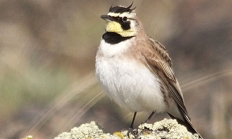
Wide open spaces generally surround these sparrow-sized, ground dwelling birds. The upperparts are mostly brownish and the underparts are generally buffy with varying amounts of yellow on the throat. There is black on the breast and side of the head, but the most unique features are small black "horns." Females and immature birds are duller. Interesting behavior includes aerial displays and "flight songs" during courtship, and the propensity to forage and loaf along dirt and gravel roads. In western Oregon, it breeds in small, scattered populations throughout the Willamette Valley, with concentrations in the central valley on and near Basket…
The bright yellow, red, and black plumage of the male Western Tanager, so conspicuous in open situations is very obscure in forested areas where it tends to blend into the shaded foliage. The species perhaps is best known in migration when it visits city parks, orchards, and other open urban and suburban areas. It is attracted to birdbaths but seldom to bird feeders. It breeds in open coniferous forests and mixed coniferous and deciduous woodlands, primarily in mountains. They usually nest in conifers - rarely deciduous trees - at varying heights, usually well out on a branch, often at the…

The Red crossbill is aptly named for its unusual bill configuration of crossed upper and lower tips of the mandibles which it uses to pry seeds primarily from native conifer cones. Degree of bill crossing is variable depending on wear, and it can have a right or left cross. Adaption to varied conifer cone structures and sizes has resulted in a diversity in body size, bill size and shape, and palate configurations in Red crossbills. Juveniles are brown with heavy streaked undersides and faint buff wing bars. Mature males are red with dark brown flight feathers and tail; first-year males…

The common muskrat is the largest arvicoline rodent on Oregon. The body is heavy and rounded, and except for the tail and feet, heavily furred. The eyes are beady; the ears are rounded and almost covered with fur; the tail is flattened laterally, scaly, keeled, and naked except for a few hairs on the keel. The forefeet are relatively small, but the hind feet are large and partly webbed. The pelage consists of an exceedingly dense underfur usually overlain by glossy dark-brown guard hairs; the underfur is waterproof. Reddish, blackish, silvery, and white individuals have been recorded. In Oregon, muskrats…

The coyote is a typical canid intermediate in size between the foxes and the gray wolf. The pelage of the coyote is grayish, buff, pinkish cinnamon, or brownish, or a combination of those colors, often overlain by blackish tipped hairs on the ears, muzzle feet, and dorsum. The lips and eyelids are black, accentuated by contrasting borders of white fur. The underparts are paler than the remainder of the body. Considerable variation in color and markings of coyotes is evident among individuals and regionally east and west of the Cascade Range. True albinos with pink eyes and pink foot pads…
