Search myodfw.com
Showing 1001 - 1020 of 1302 results
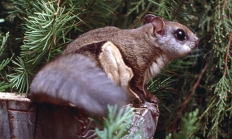
The Northern flying squirrel is the smallest arboreal squirrel in Oregon. It is typically squirrel-like except that the fore- and hind legs are connected by a furred patagium that extends from the ankle to the wrist. It is lead colored with buffy brown to brown tips. It occurs in forested areas west of the Cascade Range and eastward to near Lakeview, Lake County and Paulina Lake, Deschutes County. The species also occurs in the Blue, Ochoco, and Wallowa mountains. Northern flying squirrels are mostly nocturnal although individuals may be observed abroad during light hours on rare occasions. They are usually…
Oregon has five species of pocket gophers that are specially equipped for digging and tunneling. They have large-clawed front paws with small eyes and ears. Sensitive whiskers help them navigate underground.
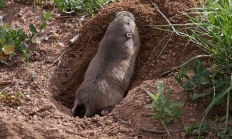
The Botta's pocket gopher tends to be dark rusty-ocherous on the dorsum and light buffy-ocherous on the venter; the nose is dusky and the feet and chin are white. This pocket gopher is territorial; only during the breeding season can more than one individual be found in the same burrow system. Burrow systems do not cross each other, but spacing within and between burrow systems is remarkably uniform. In Oregon, this gopher occurs as disjunct populations: one in Curry County only, the other in southwestern Klamath County, southern Jackson County, and western Josephine County, with an extension through central Douglas…
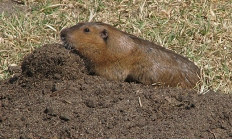
The camas pocket gopher is the largest member of the genus, although large size is not a distinctive feature of the species. This gopher is a dark, sooty brown on the dorsum; the ears and nose are blackish. The venter is lead colored except for an irregular and variable-shaped patch of white on the throat. The winter pelage is long and furry; the summer pelage is short and coarse. The camas pocket gopher is one of the most vicious animals known for its size. Nevertheless, these pocket gophers flee from potential predators whenever the opportunity arises. This pocket gopher produces…

The Western pocket gopher is one of the two small pocket gophers in Oregon. Depending on the region, the pelage of this gopher ranges from pure black with purplish and greenish overtones to brown to hazel to yellowish hazel on the dorsom and from lead colored to buff to ocherous on the venter. The face is lead colored to black. The Western pocket gopher constructs burrows beneath the surface with a vertical tunnel connecting deeper burrows that include the nest. This gopher occurs from the Columbia River to the California-Oregon border in the Coast Range and along the coast. It…
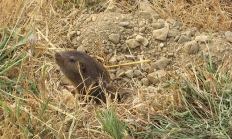
The Northern pocket gopher is the other small pocket gopher in Oregon. Its dorsal pelage ranges from a rich brown to a yellowish brown or buffy gray; the venter is lighter and usually washed with buff. This gopher builds extensive burrow systems which consist of both near-surface and deep runways connected by a vertical shaft. The nest cavity is commonly situated in the deep runway with blind tunnels radiating from near the nest that are used for food storage and as a latrine. The Northern pocket gopher occurs throughout Oregon east of the Cascade Range.

This group of rodents includes mice, voles, rats and muskrats of various sizes, but they all share one trait - their dentition is highly specialized for gnawing.
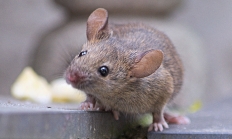
The Little pocket mouse is one of the smallest rodents in North America and certainly the smallest in Oregon. The dorsal pelage is pinkish buff to ocherous buff with overlying blackish hairs; the venter is buff. The tail is bicolored. In Oregon, this mouse occurs in Harney and Malheur counties. They exhibit their greatest activity from spring through autumn and spend a large portion of their lives in burrows below the surface of the ground. In winter, they remain underground continuously, relying on stored seeds for energy. When active on the surface, a large portion of their time is spent…

The Great Basin pocket mouse is the largest member of the genus in Oregon. The dorsal pelage of this mouse is pinkish buff or ocherous buff overlain with black hairs; the venter is white to buffy. A lateral line, usually somewhat olive colored, separates the dorsal and ventral pelages. The tail is distinctly bicolored. In Oregon, it occurs thought east of the Cascade Range, except it does not occur in the Wallowa and Blue mountains. The Great Basin pocket mouse constructs burrows below the surface that contain granaries for storage of food, a nest cavity, and several entrances. They spend…

The California kangaroo rat is the largest kangaroo rat in Oregon, but is only of moderate size within the genus. It has a moderately broad face, relatively large ears, and awl-shaped lower incisors. The tail is 150 percent of the length of the head and body. It is the darkest-colored kangaroo rat in Oregon. The pelage of the dorsum is composed of hairs with dark-gray bases, a narrow dark-buff band and black terminus. The venter, feet, upper lip,; and base, sides, and tip of tail are white and there is a white spot above each eye and behind each ear…

The Chisel-toothed kangaroo rat is an intermediate-sized kangaroo rat with a narrow face, small ears, and flat-faced, nearly square-edged lower incisors shaped like miniature chisels. Among kangaroo rats, the cheek pouches in relation to the size of the head are exceptionally large. The pelage on the dorsum is composed of hairs with medium-gray bases, a buffy band, and a tiny blackish tip, overall a dirty-sand color. The venter, upper lip, feet, and base and sides of the tail are white and there is a white spot above each eye and behind each ear. A black moustache, eyelids, ears and tail…

The Ord's kangaroo rat is a medium-sized kangaroo rat with awl-shaped lower incisors. It is the lightest-colored kangaroo rat in Oregon; overall the dorsum is a rich buff with gray overtones. The venter, upper lip, feet and side of the tail are white; there is a white spot above each eye and behind each ear; and a white stripe crosses each thigh. The moustache, eyelids, and ears are blackish. In Oregon, it occurs east of a line connecting The Dalles, Hood River County; Sisters, Deschutes County; and Lakeview, Lake County except in the Ochoco, Blue, and Wallowa mountains. Although occasionally…
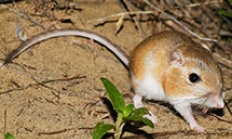
The Western harvest mouse is the smallest sigmodontine rodent in Oregon. It occurs east of the Cascade Range, except it is absent from the Blue and Wallowa mountains; it also occurs in the southern parts of Josephine and Jackson counties west of the Cascades. The Western harvest mouse commonly uses runways. It is active nocturnally with its greatest activity between sunset and sunrise. They spend periods of inactivity in ball-shaped nests constructed on the surface of the ground; nests are sometimes placed beneath shrubs or debris. Photo by J. N. Stuart, Flickr
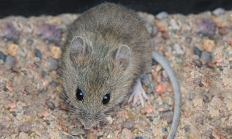
The canyon mouse is a moderate to small-sized mouse-like rodent with a long tail, nearly naked ears and a long, lax, and silky dusty gray pelage. In Oregon, most locations where the canyon mouse has been found are in Harney and Malheur counties, but the distribution includes a group of localities in Crook, Jefferson, Wasco, and Wheeler counties and another group in Lake County. There are also records of the species in extreme southeastern Baker County. Rock, primarily rimrock and talus slopes, seems to be the key component of habitats occupied by the canyon mouse. They are usually active nocturnally…
The deer mouse is a moderately small mouse-like rodent that exhibits considerable variation in color, tail length and markings. In general, the pelage of adult deer mice is buff to dark brown on the dorsum and white on the venter. The ears are moderately long, essentially naked and usually held erect and directed forward. The eyes are black and beady. The deer mouse has the broadest distribution of any species within the genus and occurs throughout Oregon. Below the treeline, it occurs as part of essentially all communities. It is active nocturnally, the time of onset of activity is cued…

The piñon mouse is the largest member of the genus in Oregon. It is characterized by its enormous ears. Hair color varies geographically; overall, in central and eastern Oregon it is a pale-buff color with a wash of black on the dorsum, whereas mice from southwestern Oregon are bright ocherous on the shoulders and flanks and a dirty brown on the dorsum. In Oregon, the piñon mouse has been found in Josephine, Jackson, Klamath, Lake, Deschutes, Jefferson, Grant, Crook, and Harney counties. East of the Cascade Range it is almost always associated with western juniper in rimrocks. In southwestern Oregon…
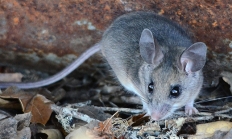
The Northern grasshopper mouse is a stockily built mouse with a thick tail. The dorsal pelage is dark sepia long the midline grading moderately sharply to a light tannish along the sides. The ventral pelage is white. A dark sepia line extends across the face between the eyes. The ears are thinly furred, sepia on the external surface and light grayish-tan on the internal surface. The feet and tip of the tail are white. In Oregon, Northern grasshopper mice have been found in grassland and desert areas in Crook, Deschutes, Gilliam, Harney, Jefferson, Klamath, Lake , Malheur, Morrow, Sherman, Umatilla…
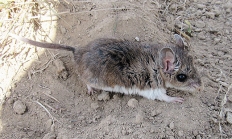
The bushy-tailed woodrat is a large rat-like mammal; its squirrel-like tail unique among members of the genus, is gray above and whitish below. The dorsum is buffy gray to dark brownish-black and the venter is white to buff depending on the geographic race. It occurs, statewide in a wide variety of habitats. It is active nocturnally. Sometimes, upon leaving the protection of its den, the woodrat may lie motionless on a rock or limb, watching for a long period before moving forth. Photo from ODFW

The dusky-footed woodrat is a medium-sized rat-like form with large, nearly naked ears, protruding eyes, and a long tail. The dorsal pelage consists of hairs with steel gray bases, a band of ocherous buff, and a tip of black. Hairs on the throat and belly are white. Although variably in extent, a dusky splotch occurs on the dorsal surface of the white feet. In Oregon, this woodrat occurs from the California border northward along the coast to near Bandon, northward inland through the Willamette Valley and other interior valleys to near Mollala and Monmouth, and northward to Brownsboro, Jackson County…
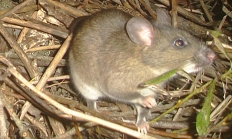
The desert woodrat is the smallest member of the genus that occurs in Oregon. The tail is round, short and bicolored and the ears are long and lightly furred. The pelage is long and soft, a mixture of buff and black dorsally and whitish or light buff ventrally; except for he chest, all body hairs have lead-colored bases. The feet and underside of the tail are white. It occurs in Malheur, Harney, and southern Lake Counties. Throughout its range, it tends to be a habitat generalist, but in Oregon it usually occurs in sagebrush habitats, especially those associated with rimrocks…